

Your sustainability report – free of charge
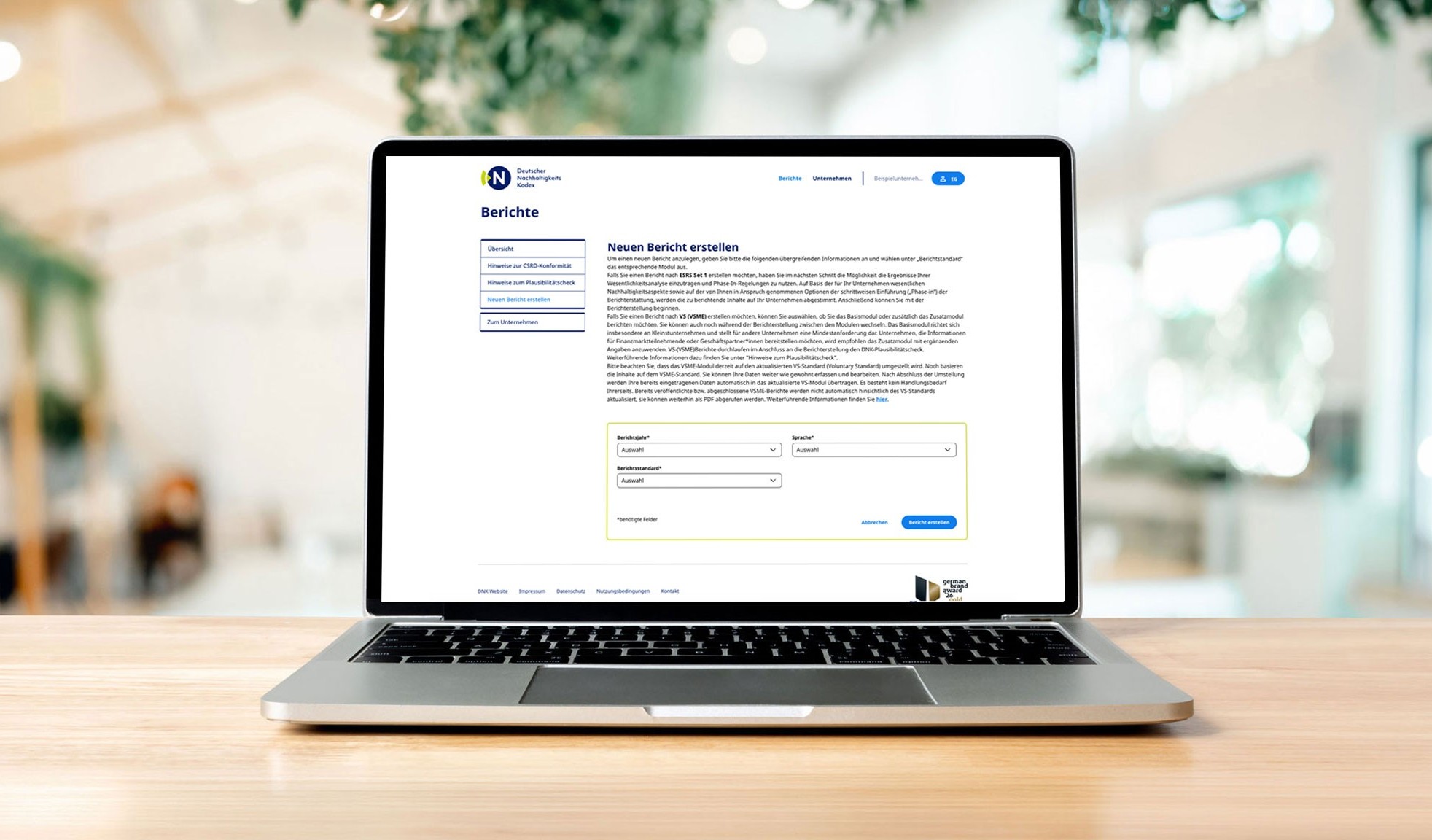
This page is your gateway to the German Sustainability Code (DNK) Platform. This platform walks you step by step through the European Sustainability Reporting Standard (ESRS) and the Voluntary Sustainability Reporting Standard for non-listed SMEs (VSME; now the Voluntary Standard (VS)). Use your email to register.


All signed up? What to expect on the DNK Platform
- DNK Checklists: ESRS, VSME and VS requirements explained in easy-to-understand language.
- DNK assistant: Step-by-step guidance for every stage of the report.
- Progress indicator: Keep track of your progress as you work.
- Teamwork: Use the comment function to assign tasks.
- Sector-specific support: Practical tips and examples developed in collaboration with more than 20 trade associations.
- Optimised readability: Display your completed report as continuous text – ideal for final checks.
- DNK plausibility check: Have your finished report checked by an independent expert reviewer for consistency and formal completeness.
- Export options: Export your finished report as a Word, PDF or XBRL file.

Actively supported by leading industry associations – with sector-specific guidance
In a pilot process involving more than 20 industry associations and their member companies, VSME guidance was developed that takes the specific needs of each sector into account. The guidance and practical examples are directly integrated into the DNK Platform. Using the sector classification stored in the company profile (NACE codes), the platform automatically displays relevant information for each VSME data point.

Small and medium-sized enterprises in particular need solutions that are easy to understand, practical and ready to use. That’s precisely why we developed the DNK.
Victoria Diekkamp-Reimann